
Letter from Altadena
Writing from an apocalypse.

Tuesday was a mess even before the fire.
On Monday night I barely slept; I live on the edge of the Arroyo Seco, the very westernmost sliver of Altadena, and when the wind whips up the arroyo the gate next to my bedroom bangs and bangs against the side of the house. It started at two am, relentless. I gave up trying to sleep around five; went to the bathroom, brushed my teeth, delayed making tea and starting the day. At six am on Tuesday, the power went out.
My parents were in town, visiting from Cleveland. They stay near my brother, a few miles to the east, in a little rented cottage in the lower canyon of Sierra Madre, just a couple blocks below my brother’s place.
I moved here almost a decade ago, just after my twin niece and nephew were born, to be their full-time caregiver. I stayed first in my brother’s guest room and cast a wide net on Craigslist and after two weeks I lucked out: a very affordable one-bedroom in-law unit, part of a beautiful house in the unincorporated town of Altadena, twenty minutes west on the freeway.
On the map Altadena is an upside-down U, an arc against the San Gabriel mountains just north of neighboring Pasadena, bounded by the sharp ravine of the Arroyo Seco on the west and the ridges and gullies of Eaton Canyon to the east. A handful of canyon neighborhoods wriggle off the northern and eastern periphery, nestled into the flanks of Mount Lowe, tendrils growing from the main street grid. To drive across all of Altadena is only about five miles at the widest point, but within that small area the town is split into distinctive eastern and western halves by the long north-south divide of Lake Avenue. The place I moved into was a lovely little spot, pressed against the arroyo, teetering on Altadena’s western boundary — and only three minutes more to my brother’s house on surface streets, a beautiful drive, through the center of town on Altadena Drive and then tracing its eastern edge along Eaton Canyon, where Altadena Drive runs into New York Drive and is forced south by dramatic topography, towards Pasadena and its eastern neighbor Sierra Madre.
Exhausted and out of power before I could caffeinate, I was already grouchy when my dad texted early on Tuesday morning: he was changing the plan he’d made the previous night with me and my brother to get him to a doctor — he’d caught a cold traveling at the holidays, which had aggravated his severe asthma, the coughing from which had triggered his hernia — and could I come over now to take him to urgent care instead? I replied curtly that I wasn’t ready to go yet but if he could wait, I’d be there soon, after I got dressed and stopped to get some tea. I moved slowly, sluggish in the Santa Anas; Edgar, the young local meteorologist that I follow on Facebook, had issued some intense warnings for this windstorm and I wondered if I should take my laptop and a few essentials with me just in case a tree limb landed on my roof, but it wasn’t supposed to get bad until later and I thought I’d be back in a couple hours anyway so I headed out lightly on my usual route, north to Altadena Drive and then east; I turned onto Lake, just barely, to stop at Cafe de Leche for a matcha latte with oat milk and a chia pudding, then back onto Altadena Drive, etched along the bottom of Eaton Canyon. I texted my dad that I was on the way, and he replied that he’d already taken an Uber to an urgent care in Pasadena. I rolled my eyes and turned south.
I picked up my dad and we went back to Sierra Madre to a swirl of questions about his health, whether they should rent a car, the errands that needed doing; the kind of logistical and emotional labor that comes with having parents in their seventies. I walked them through their concerns and after we determined that it was better if they didn’t rent a car, I took my mom to run errands. The wind in Sierra Madre had been mild but as we drove to different stores it picked up, kicking dust and plant matter of various sizes across the windshield, aggravating my mom’s anxiety. I meant to put fuel in my car but I forgot.
My car is new, to me at least: a Toyota Mirai, a hydrogen fuel cell car. They’re wildly expensive to buy new but they depreciate rapidly as used cars because the market is so niche — hydrogen fueling stations only exist in California and even here they’re sporadic, rare enough that fueling up is something to plan around. There’s a station in Pasadena, on Allen, just above the 210 freeway, so popular that there’s often a wait as the machines repressurize from overuse. I had meant to stop by and fuel up on Monday night, after we’d had dinner at my brother’s house, but it was late when I left and the route from his place to mine had become so automatic by now, after so many thousands of trips back and forth, that to deviate from habit is to fight against reflex, a battle I often lose.
By late afternoon my trunk was full of groceries and my mom had crossed everything off her to-do list. We drove back to their cottage, where my dad had been resting, and I talked them — two retired teachers, who’d worked in all-Black schools in Cleveland and East Cleveland — into watching the pilot episode of “Abbot Elementary” before we sat down to a simple, early dinner. I was exhausted so after we cleared the plates I said, I’ve gotta head home.
Be careful driving, my mom said, with all that wind.
I will be, I said: but remember, I’ve driven this route thousands of times over the years. I’ll be fine.
*
It was a bit past six-thirty when I left the canyon, a few blocks south and then a right turn to go west through the small town. There are no stoplights in Sierra Madre; it’s a place where everyone drives quietly but after I passed the two blocks of downtown (limit fifteen miles per hour) a truck sped out from behind me and zoomed down the street — anger rose in my chest but the winds gusted and I thought, okay, maybe they have some kind of emergency to deal with, imagining a tree on a roof.
Just before Pasadena High School I made my usual right turn, northwest to New York Drive, towards Altadena, only to see that it was blocked off just ahead. I thought there must be a downed tree, maybe an exposed power line, so I hooked another quick right onto the tree-lined street running along the golf course. I figured I could make an easy U-turn but once I was on the road the line of cars heading in the other direction just kept going and going, and suddenly a Jeep was barreling towards me, honking madly, driving up on the curb to avoid a head-on collision. Is… is this an evacuation? I started to wonder; and just then I crested the bank of the road and saw the wildland hillside of Eaton Canyon ahead of me, covered with flames.
I turned the wheel sharply, cutting into the cars heading out. About two minutes later, there in the line of vehicles exiting the neighborhood adjacent to the where the fire began, my phone buzzed with an emergency alert.
*
I texted my brother and my dad but reception in the canyon in Sierra Madre is spotty, and I couldn’t trust that they’d get the message; signal was bad on my end too, the network overwhelmed by all the cellphones dialing out in that endless line of cars. Coming out of Eaton Canyon I turned right, back onto Sierra Madre Boulevard, in front of Pasadena High School; suddenly the wind gusted so strong with dust and ash that all of us on the road stopped, unable to see even a couple feet ahead, a whiteout like we used to get in blizzards back in the Northeast. The wind passed, and I kept driving. A right turn on Orange Grove, looping west across northern Pasadena towards my house, dodging downed trees and limbs as the traffic pouring out of Altadena pressed southwards. Lights were out or blinking but we all remembered to treat it as a four-way stop.
Finally I spoke with my dad: pack a bag, I said; I’ll loop around to get you.
On the western edge of Altadena the streets were calmer, dark with the power outage. The wind was blowing eastward so my neighborhood was clear of smoke. I pulled into the driveway and ran into my house with my phone as a flashlight, grabbing a bag and my folders of important documents first, throwing in clothes as I remembered them: underwear, tshirts, pajamas, a sweatshirt. My travel bag of toiletries, my laptop. I stood at the doorway of my kitchen to take one last look, reviewing what I’d grabbed, and snagged a few of my favorite tea bags from the shelf at my side. As I tossed the duffel into the backseat I looked to the northeast, the snake of flames running across the darkened hillside in a wide bright gash; I looked up to the sky, smokeless where I stood, Orion’s belt twinkling clearly against the black ink. I looked to my house, where I’d lived for over nine years, where I’d rebuilt my life after a decade of instability and regular homelessness; I thought of the art on my walls, the paintings from my aunt and from my dad’s friend Harry and from my childhood neighbor Deanne; I thought of all the beautiful things I’d brought together and all the beautiful times I’d had there and as I pulled out of my driveway I said out loud, my voice cracking: thank you; thank you for being such a good home, and I hope we meet again soon.
*
What I want to tell you about Altadena is that none of the reporting has gotten it quite right, but then again, no one story could; that “historically Black middle-class suburb” is significant, that there’s no Altadena without it and that if the media needs a hook then I’m glad that’s the one they chose — but there’s also more texture to this town. Over two hundred employees of Caltech and JPL (NASA’s Jet Propulsion Laboratory) lost their houses; JPL is at the northern mouth of the arroyo, on the western edge of town, not far from my house. Twenty percent of teachers and staff at Pasadena Unified School District lost their houses. Six members of my LA-wide Women Who Submit chapter lost their houses. Altadena was a place where Black folks, scientists, educators, and artists could all find homes, at least on the west side of town; east of Lake, the major north-south bisection, houses and lots are significantly larger and the population is much whiter. That whiteness has been moving westward too, a shift visible to me in the nine years I’ve been here, but plenty of Black and brown homeowners have held on to their generational wealth nonetheless.
I want to tell you that I joined the Altadena Buy Nothing group around 2017, when it encompassed all of western Altadena; and then we got too numerous so the group split in two, and I was in the group west of Fair Oaks; and during Covid our group grew and grew, coordinated by dedicated admins like Claudia — who lost her house — and rich with gives like the twice-a-week food offering from Cathy and Bryce — who lost their house — that they rescued from Whole Foods in Pasadena. Jeni started a Little Free Plant Stand, modeled on the Little Free Library; her house is still here, although the one next to it burned, a spot fire that crossed Lincoln. The group split again this past fall, too big and unwieldy for the admins to manage, and it was contentious; it felt like severing a significant community artery, and activity in my new group — for those of us west of Lincoln Avenue — was much quieter.
What I want to tell you about Altadena is that the farmer’s market — in Loma Alta Park, in the northwest corner of town — was not like other farmer’s markets; it wasn’t on the wealthy east side but far to the west and when I started coming to it, occasionally at first, it was run by a woman named Stacy, a Black woman who was passionate about food access and supporting Black, brown, and queer farmers and food producers, with an emphasis on the hyperlocal. In 2020 the market became a pre-order/pick-up operation and in the chaos of Covid it evolved into the metronome of my life, Wednesday market pickups marking time when so much else was in disarray, and then the in-person market once the county allowed reopening, getting to know Ken and Christina and Jake and all the vendors.
What I want to tell you about Altadena is that Stacy moved to Chicago and tried to find someone from Altadena or at least the Northeast LA area to take it over, and there were multiple offers, but the County pulled some bullshit and — in a sudden announcement — awarded the operating license to an organization headed by a white woman in Malibu, which ran farmer’s markets in three Southern California counties; their website claimed they were “grassroots” and also trumpeted corporate sponsorships from Toyota and Coca-Cola, and when I dug into the tax records of their nonprofit it became clear that it was nothing more than a holding entity for market operating licenses, funneling all the money into their for-profit online commerce platform. I shared the news with the vendors, and they weren’t surprised. And what I want to tell you about Altadena is that instead of giving in, Rafa — a single mom and Brazilian immigrant, who ran the market after Stacy moved to Chicago — maintained it as a pre-order model, so the community could still support our own.
I want to tell you about how the market moved from Loma Alta park to pickup at Pizza of Venice, a local shop at Ventura and Fair Oaks, and I was so happy because now I had a pretext to get dinner there once a week, because Pizza of Venice was as fuck-it-why-not as anything else in Altadena: a Black-owned pizza shop whose gluten-free crust consisted of thin-sliced potatoes, shaved and layered and then fried and topped, decadent and delicious. Whenever friends came to visit me, we went there; and now with weekly stops for the market I became equally obsessed with their chopped salad, wildly herbaceous and marinated to acidic perfection; I ordered it so many times without meat that they changed the menu, offering it vegetarian by default, the meat available for an extra charge.
What I want to tell you about Altadena is that a few weeks ago I was meeting a friend in Highland Park and on the sidewalk someone recognized me: one of the employees of Pizza of Venice, who had left but who knew me by my blue hat. I’d given her some homemade fermented lemon-and-herb paste when I brought jars of it to all my friends at the farmer’s market, and she still used it. I want to tell you that in the LA area your local celebrities mean something about where you live and during Covid some famous food influencer moved to Altadena and I guess Mandy Moore lived here too but the only celebrity I ever heard about in the community was Maria Bamford, the legendary alt-comic, who would perform 8 AM pop-up shows at the 35-seat microtheater Public Displays of Altadena, in the same block of shops as Pizza of Venice; PDA’s programming was random and eclectic and I never replied fast enough to get a ticket to a Maria Bamford show but walking there from my house, getting dinner at PoV or from the Tacos 210 truck that parked around the corner on Ventura and had the most spectacular range of vegetarian tacos, then seeing whatever PDA was putting on, was one of my favorite ways to spend a Friday night: weird and local and perfect, like Maria Bamford (known to show up at community events and tip generously), like Altadena.
Eventually Pizza of Venice got approval from the county to turn their storage area into additional dining space and the market had to move and so it went first to a local plant nursery and then to Rafa’s house, where she ran it out of her garage with Leigh and Anna; and what I want to tell you about Altadena is that all three of them lost their houses, that PoV and PDA and the tattoo parlor in between them are gone, that I watched the video of them burning on Instagram; that Omar got the Tacos 210 truck out in time but who knows when he’ll come back and that the only thing that remains on that corner is the wooden picnic tables outside of Pizza of Venice where I sat so many times: with various friends, with my niece and nephew, with strangers and neighbors and by myself; that somehow — somehow — the picnic tables are still there, blackened but intact when everything else is gone.
I want to tell you that when houses burn down the only thing left standing is a chimney, arising from the char like a headstone, and what I want to tell you about Altadena is that the streets of my beautiful town are filled with them now, a cemetery of thousands, a graveyard of all the creativity and community and weirdness that thrived here just moments ago, alive again in memory every time I close my eyes.
I want to tell you that on Wednesday — the day after the fire began; the day of the firestorm; the day so much of Altadena was destroyed — I saw a quote widely shared on social media that said: Altadena is a suburb like any other. And I want to tell you how badly wrong this is, how wildly special this town was, how fiercely loyal we were and are to our local businesses, to our community groups, to each other. I want to tell you that when the LA Times called us a “mountain town” that wasn’t quite right either; we’re in the foothills and most of Altadena is gridded streets, a typical urban or suburban layout on a sloping alluvial plain, and I want to tell you that most of what burned was on these gridded streets, that the canyon neighborhoods suffered losses but are more intact than the town core and that the fire experts that I’ve seen talk about this seem stunned by it. I want to show you on a map how bizarrely this fire moved, that it began as wind-driven wildfire but it did most damage as an urban firestorm, churning more than two miles south through the street grid, from the roads abutting the edge of the mountains well into neighborhoods that CalFIRE had never deemed high-risk, and spitting ash in its wake. I want to tell you that Altadena burned like Chicago, not like Paradise; and I want to tell you that no matter where you live, no matter how protected you think you are, that everything can disappear in an instant; that you can head home on the route you’ve driven thousands of times and turn an unexpected corner into a wall of flames, and nothing will ever be the same.
What I want to tell you is that I am so extraordinarily lucky, to still have a house here, I am so extraordinarily fucking lucky; but that everyone in Altadena has lost their home.
*
After I left my house on Tuesday night I headed southeast, to pick up my parents in Sierra Madre — they were just a few blocks from my brother’s house but he and my sister-in-law only had one car at the moment and between the two of them, my niece and nephew, their dog and their two cats, there was no way my parents could fit. Traffic was jammed going south on Los Robles and a distance that usually takes five minutes took nearly half an hour, but once I turned east on Orange Grove I could drive quickly again; nobody was going to Sierra Madre now, and I was terrified that they might close the canyon before I could get in, but I made it and my parents still had power in their cottage, even as the red glow of the fire was visible on the ridgeline above. I emptied all the groceries I’d bought earlier that day from my trunk and loaded it with their bags while my dad spoke to his brother in Chino Hills — “we’ll be there,” my dad told him, and I interrupted to say we might not, it depends on whether or not I can fill up on hydrogen.
The smell of smoke permeated my car even as I kept all the windows closed and the air-conditioning on and even with his KN-95 my asthmatic father struggled but to get from their cottage to the hydrogen fueling station meant driving straight through the worst of it, the gusting winds raining ash on my white car. We got to the station and there was an open pump, although a car getting gas was stopped close behind. I backed in quickly — too quickly — and it was like a cheesy scene from a disaster movie, a gag of cheap suspense: I was too far away from the hose by an inch, had to open the car door again while my dad coughed, back up the barest amount, then try again; finally, triumph. There wasn’t enough pressurized hydrogen available to fill the tank, but it gave me another hundred miles of range, and that was enough.
So much time on the road amongst hazardous conditions and panicked drivers had flayed my nervous system — it was almost 9:30 by then, nearly three hours after I’d left my parents’ cottage after dinner, three times as long as it should have taken to go there and back. I called my sister-in-law to verify that the route to my uncle’s house was safe and she said the 210 eastbound was completely clear, so I turned the car back on and kept driving.
*
What I say at first is: they stopped the fire at Lincoln. But this is a lie.
The winds shift that night; the clear skies over my house disappear into clouds of smoke and ash, into embers and char, whipped down from the mountains in gusts topping one hundred miles per hour. Western Altadena isn’t ordered to evacuate until 3:25 AM on Wednesday morning; my phone buzzes with the alert just as I’ve finally put it down, next to the couch where I try to sleep at my uncle’s house, thirty-five miles away in Chino Hills. I manage about two and a half hours of fitful, occasional rest, interrupted whenever the wind picks up and adrenaline startles me awake; my uncle comes downstairs at six am and I give up the pretense, gluing myself to phone and laptop in terrible vigil.
Local news and social media show a parade of destruction, a hellscape on the march. I see pictures of my town that look like Gaza and think: we do this to people on purpose, and something easy and accommodating in me disappears forever into the flames.
My niece and nephew — twins, three weeks away from their tenth birthday — spend the day watching cartoons, entertained by my aunt and uncle and parents. My brother evacuates a second time, now into video games on his computer. Their dog and one of their cats act as emotional support animals; the second cat hides under the couch where my sister-in-law and I sit, scrolling and refreshing, trying to discern whether or not we’ll have houses to return to.
In 2017 the Tubbs fire whistled through hillsides and canyons in Sonoma County to descend on Santa Rosa and, as it approached the house of another aunt and uncle — my second home during my peripatetic decade in the Bay Area, before I moved south — I latched onto the Twitter feed of the Santa Rosa Junior College, a block away from my aunt and uncle’s house. A trusted source, organized chronologically, offering regular updates.
No such feed exists in 2025; even the trusted sources are distorted by algorithms, feeds a mash-up of yesterday and today, of right now and two hours ago, and in a crisis — in a disaster — in the devouring of your entire town — those differences fucking matter, and amidst the exhaustion and foreboding the only emotion I can summon is a burning fury at the tech overlords who have ruined our digital commons for their own private gain; whose looting of San Francisco drove me from the Bay and whose plunder of basic communication tools renders a clear picture of Altadena impossible. The winds are too strong for an aerial view and satellite data is imprecise, showing hot spots everywhere. My tabs are open to three different Altadena groups on Facebook, and as I rotate between them a neighbor posts a useful tool: a Google Maps pin map of burned structures, crowdsourced, filled in as people watch the last moments of their Ring cameras from a distance, as they see the remains of their block on television, as they find a way to drive back in amongst the chaos. My sister-in-law and I refresh it obsessively and our conversation is terse, sharing what we learn from our various feeds: Doug’s house is gone. Marcy’s house is gone. Jeff’s parents’ house is gone.
A litany — Gone. Gone. Gone. A rosary of collapse.
I didn’t realize how many of my colleagues lived in Altadena, says my sister-in-law, a Caltech astronomer like my brother.
The crimson pins on the Google map congregate thicker and thicker, as morning becomes mourning. The reported death toll ticks upwards. In Chino Hills, the sun is out.
My friend Sara texts me — all of my friends text me, and it is exhausting and lovely and I have absolutely no idea what to tell any of them — but Sara is passing by Chino Hills, evacuating from her smoky apartment in northeastern LA to her parents’ house in San Diego, and she wants to know if I’d like to meet her for lunch. We were supposed to meet up for lunch that day anyway, a plan made only two days previously that now felt impossibly dim and faraway. I think: it will be good to do something besides stare at this damn map; anyway there seems to be a stall in the firestorm along Lincoln Avenue, or maybe I just want to imagine that there could be, that my house — to the west of Lincoln, not yet swallowed by inferno — might somehow be spared.
I meet Sara at quarter after eleven, at a sandwich chain in a strip mall full of chains, one island in a long commercial archipelago (Chino Hills is a suburb like any other). I can’t stop looking at my phone; I watch a video of Pizza of Venice and Public of Displays of Altadena burn and then in a group text a friend writes: The news says they just started aerial water drops.
For the first time since driving into flames the previous night, I feel something that might be called hope.
*
The best thing to know about aerial water drops is not just that they are more effective at putting out flame than hoses — although that’s true — but that they cannot be executed in high winds.
If the helicopters are up, then the winds are down.
Already the platforms and airwaves are full of anger and conspiracy, of accusations that firefighters let it burn, that nothing was being done. The firefighters are very direct: in winds over thirty or forty miles per hour, they can do little; the winds in Altadena were over ninety miles per hour, and the bare truth that the conspiracists cannot accept is that physics always wins.
*
Sara and I walk around the strip mall, across its endless parking lot. She suggests we distract ourselves at Marshall’s but after a couple minutes I am overwhelmed, panicked by the capitalist abundance of everything I might need to replace. I want to rush back to my laptop, to the Google pin map, but I force myself to wait, to connect, to embrace the uncertainty; besides, I know it will take time for a coherent picture to form from the chaos.
I get back to my uncle’s house around three. The CalFIRE map is finally updated, its contours mostly matching those Google pins, the shape of the burn scar established over two-thirds of Altadena. The western edge of the burn scar runs down Lincoln Avenue and the westernmost half-mile of town — the half-mile where I live — is a crescent moon mostly intact, a fingernail on a phantom limb.
On the eastern edge of the fire in Sierra Madre my brother and sister-in-law’s house is still standing, the two of us parentheses around a conflagration.
Spot fires and red flag warnings persist. The National Guard moves in, cordoning off the burn zone and the area around it. We cannot return yet.
Corrections filter out. The library was reported burned on Wednesday morning but late in the afternoon they post: as of 4 PM the library is intact. Buildings burned on three sides and it feels somehow miraculous; I still cannot speak the words “The library is still here” without getting choked up, even as I sit inside it now and write these words, the day of its reopening, eight weeks to the day after the Tuesday that changed everything.
The county creates a map of all the properties in and near the burn zone as they assess them, and what quickly becomes apparent is that fire lands unequally; that the dense, less-wealthy western side of town burned more thoroughly than the richer eastern half. CalFIRE and insurance companies talk about “defensible space” but such a concept requires space, and the small lots — infilled with ADUs — of western Altadena made quicker kindling than the genteel east. Smarmy internet commenters point out that Altadena burned before, that the 1993 Kinneloa fire destroyed a couple hundred homes, but they do not take the time to look at the maps of the fire lines, to see the monstrous difference in the footprint of the Eaton Fire; because in that monstrous difference there is no room for smugness or schaudenfraude.
It is easy, after all, to mock the rich celebrities fleeing their canyon mansions in the Palisades; it is easy to refuse empathy for those who can afford to rebuild, for those who valued views and square footage over a commonsense approach to fire risk; it is always easy to be that kind of asshole. But what I want to tell you about Altadena is that so many of the homes that burned on the west side were nearly a century old, that they burned not because of their exposure to hillsides and brush but because of their proximity to each other, and that such a fire can happen anywhere, that to imagine this as Californian folly is to reveal nothing more than one’s own ignorance.
What I want to tell you about Altadena is that the evening the fire began, when I sat with my parents and had dinner in Sierra Madre, we talked about the Palisades fire and I shocked them with a bit of history: that the deadliest wildfire in American history happened not in California, not anywhere in the West, but in Wisconsin, on the shores of the same Great Lakes my parents believed to be so climate-resilient: the Great Peshtigo Fire, which burned a million and half acres and claimed thousands of lives on the same night as the Great Chicago Fire, both of them the result of the same weather conditions; because ultimately a fire needs only three things to become a maelstrom, and the trinity of drought, fuel, and wind is obtained easily enough anywhere, just waiting for a spark.
In 2018 I visited the Bay Area and my aunt in Santa Rosa — a county employee who transferred to the fire recovery team as soon as it formed — took me to the Coffey Park neighborhood, leveled by the Tubbs Fire. The lots were cleared by then; one house was under construction. We drove up the hill into the Fountain Grove subdivision, where nearly every house burned, despite a wide and well-maintained firebreak, despite concrete walls and sealed eaves, despite adherence to every home-hardening guideline in existence.
There is no such thing as completely fireproof; not in what we build, and not in where we build, either.
Asheville was marketed as a climate haven. On Thursday after the fire I get a message from a childhood friend, a nurse who lives there now: Friend I am so sorry. Having just recently lived through a similar devastating natural disaster, the surreal feelings of everything you know being literally wiped out, from in front of your eyes in a matter of a moments, is absolutely mind bending. I found it nearly impossible to describe to anyone that wasn't there, living it beside me. It was a whole new, completely different and unusual kind of trauma. Sending you all the love.
It is the first time I recognize myself, anywhere; a handhold across a continent, and I feel it again when my aunt texts me from Santa Rosa.
What I want to tell you about Altadena is that if it hasn’t happened to you yet, it will; that the tweet-turned-adage about climate change — “Climate change will manifest as a series of disasters viewed through phones with footage that gets closer and closer to where you live until you're the one filming it” — is a terrible truth; that when I drove through Coffey Park years ago I did not know then that I was looking at my future, and perhaps you cannot yet imagine the footage from Altadena as your own but that does not make it untrue. Because one day you too could drive into a hillside of flame; because one night, as you live your life of ordinary human drama, orange can slash the darkness and devour familiar streets, and nothing will ever be the same again; because the people of Peshtigo weren’t any more foolish than you or I; because Altadena is all around us, and Asheville is everywhere.
Because we all live in Paradise, now.
*
Some time after the fire there is a presidential inauguration, and the world moves on to a new horizon of destruction: the harms of shallow men, who can only see themselves reflected in waste and wreckage, who name the suffering of others as their own triumph; sad and empty people, at bottom, who live in total fear of their own humanity. Two men especially — born into the damning privileges of excessive wealth and monosyllabic last names — are cheered by the same online chorus who sneered at those of us running from wind and flame, just so that they could feel superior to those losing everything. Their names don’t matter; they don’t matter, none of them, not even those at the highest levers of power, because for all their damp desire for damage and devastation they are but the palest shadow of the vengeance that nature might offer; for all that they envy and seek to emulate the havoc of the wind they are nothing more than farts in a hurricane, stench striving to become storm, nuisances that will blow away, utterly unremarkable in every aspect of their petty and squalid ambition.
What is left to fear, in the aftermath of an apocalypse?
The weekend before the fire I put a song on repeat and dance in my living room: “Ogallala,” by Hurray For The Riff Raff, and after the fire it is the only thing I can listen to, over and over again, entranced by the haunting crescendo:
I used to think I was born / into the wrong generation
But now I know / I made it right on time —
To watch the world burn,
To watch the world burn,
To watch the world burn,
With a tear in my eye;
To watch the world burn,
To watch the world burn,
To watch the world burn —
I’m right on time.
It is always the end of the world, somewhere; there is no shortage of apocalypses, most of them beyond our control; and those who relish making any more are the worst kind of fools.
Physics always wins. None of this is permanent. And what else can we do in the face of such immovable truth except to love each other?
A couple weeks after the fire, Edgar — the local meteorologist, the hero whose early warnings saved hundreds of lives — posts an old map he made charting the different wind regions of Altadena, superimposed over the burn scar, structuring its maddening and impossible shape. He explains that the patchy burning on the east side of town, the survival of whole neighborhoods so close to the point of ignition, is due to a shallow ravine that caught the mountain waves — the avalanche of wind — and pinwheeled the current back on itself, casting stray embers but interrupting the roaring fire front in its voracious path; he has a degree in climate science but he’s also spent his whole life next to Eaton Canyon, spent two thousand days clearing litter from its trails, and it is this intimacy with the land that makes his knowledge so tender and valuable.
He explains, too, that the topography of Altadena creates a slight but detectable atmospheric ridging along Lincoln Avenue; I did not imagine the stall on the Google pin map, after all.
When I said they stopped the fire at Lincoln, it was because it felt comforting to assign some agency somewhere, even to an amorphous “they”; because who can’t understand the urge of the conspiracists, to make order out of seeming randomness, to want someone to be in control, somewhere?
But the truth is reassuring too, and worth saying honestly.
The fire stopped at Lincoln.
*
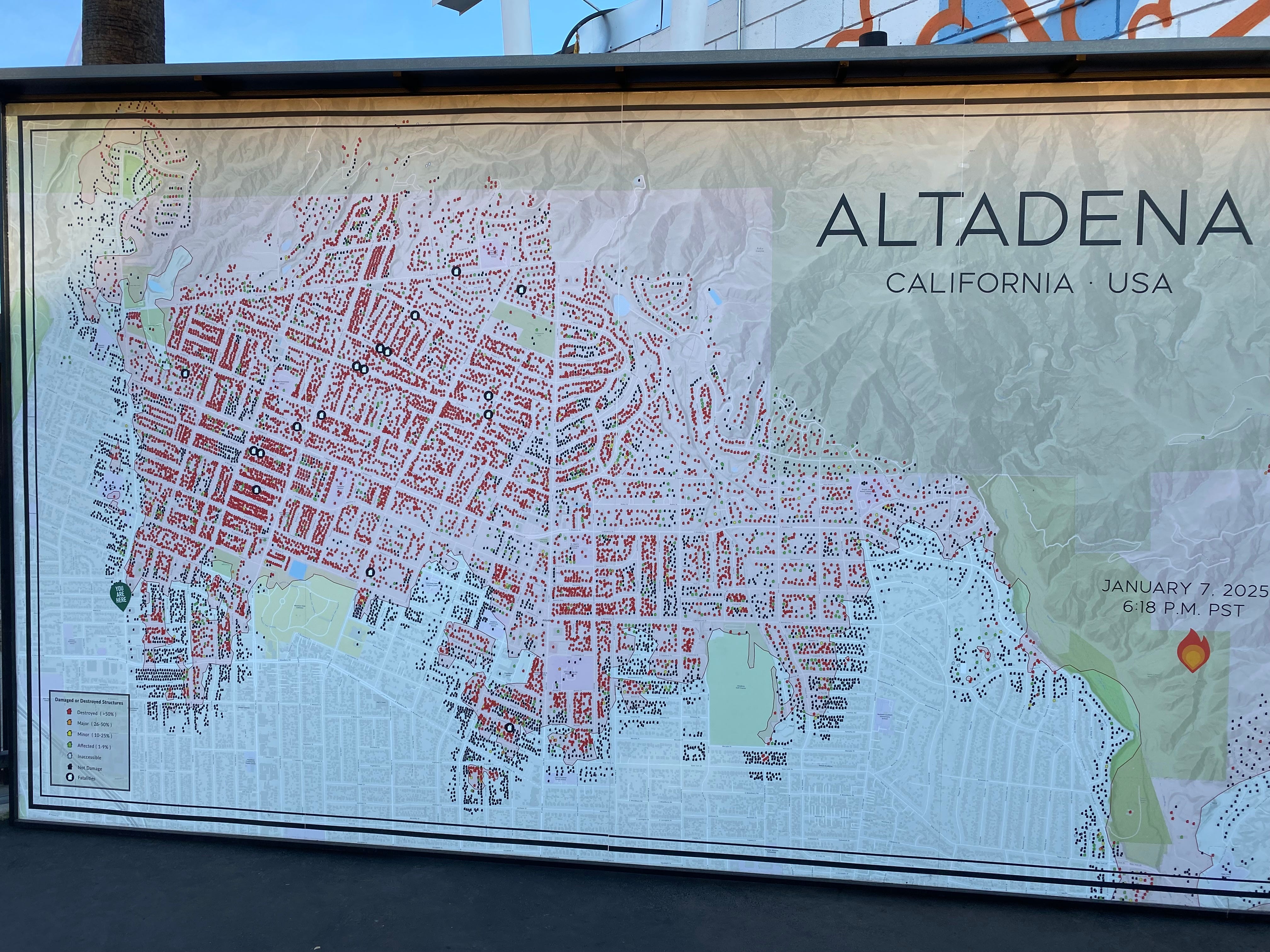
County fire map blown up and displayed at Good Neighbor Bar on Lincoln; photo by author.
*
At my uncle’s house my sister-in-law curls against my brother, and I blink against the absence next to me.
Six weeks before the sky glowed cruel amber I told the only man I’ve ever loved: we don’t know each other anymore. I said: good luck, and goodbye.
We had been in each other’s lives for five and half years and in that time we made each other laugh, often, and more than that we learned how to tell each other the truth, which is to say that we loved each other; but this was the one truth he could not tolerate, the one that he could not admit or let me acknowledge, and eventually the dissonance became unbearable. Or to put it another way: when the guy who loves you insists on pretending that he doesn’t, it feels like shit. Neither of us came from robust romantic histories — after multiple sexual assaults and traumas in college and my twenties, I had consigned myself to a lifetime unpartnered — but I thought that his reticence could be overcome if only I worked hard enough, if only I built something safe enough, if only I could prove to him that I was sticking around, no matter what.
I’m sure it will astonish no reader that this didn’t work; when I finally walked away it was inevitable and nobody in my life was surprised and yet that Tuesday night and all day Wednesday and so many days since I have wanted so badly to text him, to reach out, to share with him my fears and confusion and mundane joys and to know his; I confessed as much to my friend Sara, as we wandered around a Chino Hills parking lot — just to let him know that I was okay, I said, just to allay the anxiety that consumed him all too easily.
Isa, she told me. Your house might have just burned down. Your town is gone. You do not have to manage anyone else’s feelings right now.
That he has not reached out has not stopped me from missing him but it is the same way I miss Altadena: without any longing in it, because I know that the only reality now is the absolute certainty of absence. Reaching for his hand or wanting to text him is the same kind of muscle memory that urges me to turn left at the end of my street and I have to correct myself every time — we turn right now, we do not go into the burn scar — and to contact him would be to drive into a different kind of burn scar, but one equally hopeless.
It would be so nice to feel his arms around me, gauze on an open wound; it would be so nice, to have my town back. Both are impossible, and to think too hard about either one is to step into a dissociative freefall, an optical illusion that blurs into soft focus before snapping back to something rigid and incontrovertible.
It is better not to look.
What I eventually realized is that my efforts would never be enough to persuade him to safety because he did not recognize love as a choice but believed in it instead as a feeling, a kind of passive absolution bestowed by feminine beauty, something soft and comforting and easy, to soothe his insecurities, an escape route so that he would never have to face himself. What I offered was the opposite: we chose each other, again and again, and in this choice we both confronted fears and vulnerabilities we would rather hide from ourselves and from the world, but we learned to share them, to trust each other, although in the end it’s not enough to choose if we can’t stand by the choices we make. Ultimately our relationship was a zen koan — How do you spend half a decade in a passionate emotional affair with someone determined to remain emotionally unavailable? is just the millennial version of What is the sound of one hand clapping?, and equally unanswerable.
The symbolic purpose of fire is to cleanse, to clarify, to burn away all that is extraneous, and this metaphor has been real enough in my experience. I know now how little I know at all; but I do know that nothing is permanent, that there is no going back, and that anything that is not love is a waste of time.
In five and a half years I learned that one face of love is called showing up, relentlessly, recklessly; I learned that one face of love is called grace, freely and mutually given.
I am learning now the face of love that is called letting go.
*
One week after the fire first broke out I was sitting on my friend’s couch, recounting my evacuation story, so damn proud of myself for not having checked a screen in nearly three hours.
Evacuated zones were reopening; my brother and sister-in-law were able to return on Sunday, the two of them heading in first as an advance cleaning team, then bringing back their kids and pets and my mom on Monday, the same day my dad flew out of the Ontario airport back to clear air in Cleveland. I left my aunt and uncle’s house too; I had to work early Monday and Tuesday in LA and it was easier to sleep on my friend Katie’s floor than commute from Chino Hills. On Saturday night we all came back to my uncle’s house from a nice dinner out together and I carefully put together a bag of leftovers for myself in the fridge.
Wait, said my aunt: I thought you weren’t leaving until tomorrow?
Yeah, I told her, pausing, searching for why it felt so important to pack things up now. I think I just… really need to be sure that I have everything before I go.
On Tuesday I worked from seven-thirty am until twelve-thirty, and then headed to Koreatown to pick up lunch and share it with my friend Eli at her apartment. I forced myself to put my phone out of reach so that I couldn’t constantly refresh to see if my zone’s evacuation order would be lifted but at two minutes after four pm it buzzed and I couldn’t help but look. The text was from my sister-in-law: Hooray for the evac order being lifted for you! I couldn’t speak and Eli asked what it said.
I — I think I can go home, I told her finally, bursting into tears at the end of the sentence, sobbing for the first time since it all began.
Eli asked if I wanted company for the return and I said yes, please, if that’s not too much to ask; she told me it wasn’t too much at all, that’s why she was offering. We drove up together, unsure if there would be checkpoints and restrictions; we filled a spray bottle with water at Eli’s before we left, because the water in Altadena and Pasadena and Sierra Madre was on a Do Not Drink-Do Not Use order but I’d read carefully about how to clean up ash with wet dusting. I knew there would be ash because at some point I’d realized that I had left my bathroom window open; I always did, for ventilation, and when I’d run into my house on Tuesday night to throw together a bag as quickly as possible I hadn’t thought to close it. We arrived — no checkpoints — and the ash was less than I’d feared, a light spray across my bathtub. I said I would clean it tomorrow but Eli took the spray bottle and disappeared while I sat on my couch in a daze, too overwhelmed to do much of anything, and it was long minutes before I realized that she was cleaning for me.
The food waste was less than I feared, too; I had a bag of ice cubes in my freezer, juiced from the abundance of my brother’s Meyer lemon tree, and they were only partially melted. I threw out my fish and seafood but decided to chance it on the rest, to save what I’d foraged and preserved from a landscape where I could not gather, now. Almost nothing in the fridge had spoiled; a bag of baby spinach, half-empty when I’d evacuated, had not even wilted and I showed it to Eli with astonishment. This shit doesn’t even last this long under regular circumstances!, I exclaimed.
It’s the Miracle of the Baby Spinach, she said, and we two Catholic school alumni giggled; and nothing felt real in that moment, nothing at all, that just blocks away from such total devastation, from so many left with nothing, here I still had this goddamn baby spinach, the most ephemeral of all vegetables, somehow still intact, something so fucking insignificant persisting in the face of so much loss —
We drove out on Lincoln, turning at the charred husks of the mechanic’s yard, the National Guard out in abundance, ensuring that we went no farther east or north.
I slept at my parents’ rental cottage that night, just me and my mom now. The next day I drove back: my usual route was all inside the burn scar so I took Woodbury, the southern boundary of Altadena, the edge of the area still under evacuation order. The fire hadn’t gotten quite this far except at Glenrose, just east of Lincoln, where it reached all the way to the intersection and some spot fires crossed the road and ran down one more block, into Pasadena; news vans gathered, conducting interviews in front of the one bit of wreckage they could still access. Two blocks east of Glenrose was the Mobil station where a two-billion-dollar lotto ticket was sold in October of 2022.
There were no working streetlights. There were so many Humvees.
Friends arrived to help me clean up — Alissa, Jonathan, Danny. My neighbors returned. We hugged each other and cried. Dana and Jeanette held each other by the shoulder and remembered their friend Kim, one of the seventeen who did not make it out of Altadena one week earlier. CalFIRE moved from house to house, clearing brush along the arroyo, dismantling the log fort that my niece and nephew had built with so much care. Jeanette’s adult son Teddy waved at everyone, sharing enthusiastically how happy he was to be home. My friends gawked at the tree that had fallen onto the roof of one of the back cottages on the property where I live. We found a sign underneath layers of leaves: Faculty and staff parking only, it said, the paint only partially melted, and we wondered which school it might have come from, every option blocks away. We didn’t know when the gas would be turned back on but we weren’t supposed to use heat or hot water yet anyway; Danny brought a water jug that he’d filled up in LA and we all shared it. I stayed with my mom for a couple more nights.
It had only been a week, and yet everything was unrecognizable.
What does it mean to come home, when home has been ripped apart?
*
The next week I made a terrible mistake.
I was back living at my house but driving back and forth to my mom’s cottage most days to spend time with her and another week later — two weeks after the fire — they lifted the evacuation order on another set of zones, so that Altadena Drive was passable.
In the interregnum between my return and this — between the lifting of the order on my zone, one of only two in Altadena with minimal damage, outside the burn scar, just a few houses lost to spot fires, and the lifting of the order on zones obliterated — I had obsessed about being able to make this drive, as if going between my brother’s house and mine on this route would be a second homecoming. Part of it, I think, was simply to complete the task I’d set out with on the night of the fire, as if rerunning the scenario could undo everything terrible that had happened since; the other part of it is that the dailiness of that drive, back and forth to my brother’s house to take care of my niece and nephew, was where I learned the discipline of care, of what it meant to really show up, and the streets that I drove so many times lived underfoot as a map of that transformation. When I first moved here I would head home around 8 or 9 PM and when I turned left onto Casitas from Altadena Drive each night — nearly there — I could feel the pit of my stomach hardening, tension spreading across my shoulders; after so many itinerant years in the Bay Area — after a decade of such unstable housing, of not-infrequent homelessness and couchsurfing — I couldn’t believe in my own stability and luck and I was convinced, night after night, that I would arrive home to find an eviction notice on my door, to be cast out of my newly discovered idyll, to have the whole thing come crashing down.
It took me years to trust that it wouldn’t all just disappear.
I had dinner with my mom at the cottage in Sierra Madre and decided to drive home along my usual route; it was dark but I thought that would be the easiest way to greet the burn scar, that I would see less of the carnage, that the shadows would make it all a little less real.
I cannot express how badly wrong I was.
I say now that I have been in the burn scar four times and that number counts only the trips I have taken in the daytime because I don’t even want to remember this first drive in darkness. I don’t want to remember turning my head to the left, looking south, and seeing the lights of the LA basin where rows and rows — blocks and blocks and blocks — of houses used to obstruct the view. I don’t want to remember shaking in my car, tears in my eyes as I repeated this was a mistake over and over, knowing that there was no way out except through. I don’t want to remember sitting on my couch when I finally got home, shivering and incoherent and more bereft than I’ve ever been, and I don’t want to remember the absolute searing darkness of it all, how thoroughly night can permeate when there is no electricity to combat the shadow; I don’t want to remember the grotesquery and obscenity and vastness of so much absence, because even if I could not see the structural damage I knew — passing no other cars, just National Guard parked at each intersection, lights off, rifles out — an aloneness so total that the only way I can reckon with it now is to bury it.
The Eaton Fire is the second-most damaging fire in California history (after the Camp fire) because “damage” is measured in terms of structures destroyed, and the Eaton Fire destroyed over 9,000 structures. It is a daily disorientation to be “affected” by the fire — everything is a euphemism; we are fire-affected or fire-impacted and that means different things to different people and we talk about “loss” and just a few days ago a neighbor posted in our local Buy Nothing group I hope everyone is stabilizing after the event we all experienced and I want to reply What the fuck are you talking about, Carolyn? but I stop myself just in time — it is a daily disorientation to be in the midst of an event so defined by structural wreckage and material loss and to have suffered neither, to be rendered invisible by the metrics of capitalism; not because those material losses don’t matter — they really fucking do — but because we cannot quantify the damage to a community as readily as we can quantify damage to property; because if it doesn’t have a dollar sign, we barely even know how to define it.
I don’t want to remember that first drive through the burn scar because what hurt the most was not seeing my town destroyed but rather seeing it empty; because whether we can measure it or not, the greatest thing we all lost was each other.
*
In the daytime it is easier, because in daytime, there are people — too many people, for this low-key town; we are positively bustling now, swarmed with endless trucks and vans of all sizes. Lime green with the orange arrow logo for the ServPro franchises that have arrived from across the southwest and west coast for home remediation; white pickups for contractors and utility workers; haulers of all colors, where they tell us debris is fully sealed but it’s easy to be skeptical, driving amongst so many of them day to day, more haulers than cars, more workers than residents, disaster capitalism on my doorstep, in living color.
In articles and on podcasts people say things like Altadena was wiped off the map and I hate it. Two-thirds of the town is now wreckage; roughly half the housing stock is destroyed. There were forty-two thousand people in Altadena before the fire, and about a quarter of us are still here.
I watch a documentary with my mom about Paradise — it’s a Ron Howard film and it’s called “Rebuilding Paradise” so I think it will be optimistic but it is the grimmest thing Ron Howard has ever made. Like everyone else all I knew of Paradise was that the town was totally destroyed, gone, but the movie shows houses and neighborhoods still standing and someone who lost their house says in an interview: I almost feel worse for the people who are still here.
Ninety percent of Paradise burned. There were still twelve hundred homes, remaining.
Every night I drive home and I pass multiple signs from the federal government. CAUTION: You are entering an area damaged by wildfire. Dangerous conditions still exist. Enter at your own risk.
I can’t get to my house any other way and I can’t afford to move and I don’t have anywhere else to stay; the sign makes it out to be a choice, but what choice is there?
I’m so tired of talking about the fire but I don’t know how to talk about anything besides the fire. I go to a friend’s housewarming party and sit on the couch, barely interacting, just letting other people’s joy wash over me; I go to a friend’s Lunar New Year party and I flick the sequins on her sparkly throw pillows to make the shape of the burn scar, over and over again. Every casual conversation feels so dangerous, like I’m carrying a live grenade: where do you live is a regular question in sprawling LA and Altadena is an explosive, a conversational cul-de-sac, a real fucking bummer. I see a play with a group and a friend of a friend chats with me afterward, trying so hard to draw me out of my quietude, and I hold back until the inevitable query and when I say Altadena he pauses and then says: so where do you live now?
My friend Allis asks How are things in your neck of the woods? and Allis is a twice-divorced single mother of three, someone I don’t have to placate, and I pause for just a moment before I say, Allis, it’s fucking awful! and then I erupt into a loud, hollow laugh. Allis is embarrassed and apologetic but I tell her no, god no, it felt so good to be fucking honest for once, to not tiptoe around the truth.
Because how can I possibly be honest, when people ask how I am? How can I possibly tell anyone that everything hurts, that everything is jagged and terrible, that usually when I feel this way I hit the trails, I walk a block and a half from my house and then disappear into the mountains that I am still getting to know after so many years together, mountains that hold me so well and so generously, but all the trails are closed now; that I cannot escape the truth of what happened, even when I try, because the bare scalp of the hillsides are always right there next to us, plaintive and dusty, unfreckled by vegetation; that tenses have collapsed, that past and present are knotted together and the future doesn’t exist; that the only thing that feels good is being around my neighbors wherever I can find them, not having to explain that when I say “Tuesday” I am always referring to the night of the fire?
I order an Altadena hoodie from a local Black-owned business whose storefront was destroyed when I see it in an Altadena group on social media and then a couple days letter I get an email telling me that my order will be delayed because they’ve been inundated and overwhelmed since their appearance on the Grammys. I drive to Home Depot to pick up my air purifier and I switch through my regular radio rotation and there’s Fire Aid and in between every song someone is saying something beautiful about Altadena and I cannot adequately express how fucking surreal this shit is, how weird it is for all of you to know the name of my town when three months ago many people even in LA would say “where’s that?”, when it was a semi-secret handshake amongst hikers and herbalists and JPL engineers and Black Angelenos.
The fourth time I go into the burn scar (the fifth time, really, but the first doesn’t count) it is with my friend Jessi, who lived in Altadena for a time, at their in-laws’ poolhouse; their spouse grew up here. In early June of 2021, once we were all properly vaxxed up, I drove over to the east side of town and Jessi and I spent the most magical day hiking Eaton Canyon and then jumping into the pool; their in-laws forced them out and now they live in a bus in Washington State and their in-laws’ house burned but the poolhouse is still there, I took a picture of it and sent it to Jessi and when they are in town we drive to see it together and it is the only thing in all of this that feels anything like karma; not because of the house that’s gone, but because of the poolhouse that’s still there.
I start to read essays about the fire but most are written by people outside of Altadena and I know they’ve moved on already — to politics, to daily life — but at the farmers’ market free produce giveaway (Rafa shifted quickly, to keep serving the community) a neighbor lingers to chat (we all just want to linger with each other) and says that his wife is an emergency room doctor, that she hasn’t been able to work since the fire, that she just can’t focus like she used to. So many of the essays I read talk about how this event as profound, something that will change the writer forever, but really, Susan? You’re already writing about something else.
I know others have moved on because when the rain finally comes we brace ourselves for mudslides and debris flows and yet when I call out of work people ask if I’m sick. My brother’s house in the canyon is in the highest-risk zone — on one of the three highest-risk streets — and I’m so relieved that my mom went back to Cleveland two days before the storm. I wonder if I’m making myself paranoid, reading too much about the deadly Montecito mudslides after the Thomas fire, but on Edgar’s Facebook page my neighbors share mudflow maps and rain rate data from 2018 and at least I know I’m not alone in my anxiety.
The canyon is evacuated; no lives are lost and no homes are destroyed, although some are damaged. Mud blocks the street in for three days. The two cats stay at my house, curled on top of me while I sleep.
I am brittle, concussed with grief, blasted anew every morning when I wake up to soft light through trees outside my window and have to remind myself that it’s a mirage, a deception.
I was capacious once, and generous, and I think: maybe someday I will be that way again.
*
I am held together by my friends and family; they are bones and muscle when my body collapses, reality and presence when I lose track of where I am.
I could not have gone to my house if Eli had not gone with me. When I drive her back to Koreatown we stop for dinner at a vegan Thai spot on Hollywood; we’re the only ones there and halfway through the meal I start sobbing, as my friend Alissa wrangles folks on the group text to come out the next day and help me clean up.
As Eli and I leave our server bids us goodbye and hopes that we liked our meal. Eli says yes, it was my first time here and it was wonderful, thank you so much, and I say it was a lovely meal to celebrate being able to return to my house in Altadena, and the server’s expression is confused.
You mean… Pasadena?
No, I say, and we walk out with the confusion still hanging in the air.
Outside at the car, Eli says well, that was disappointing, and I remember how much easier life was when nobody had fucking heard of Altadena and I say: No, it was perfect.
*
The truth is that before the fire, I had decided to move.
Not soon, just sometime in 2025, maybe early 2026. And not lightly, or without resentment: the decision was forced or at least prompted by my landlord, who had been an absentee landlord until the fall of 2024, when he evolved into a present asshole. He was open about wanting to get us out so that he could reset the rent, make double what he made from all of us, apparently in retaliation that we dared to finally ask for basic and inexpensive safety upgrades, like bringing the outlets in the house up to code; we tried to placate him, to grit our teeth and let his tantrum run out, but he kept finding new ways to make life miserable.
When I first thought fuck it, maybe I’ll just move, it was out of frustration and spite and I pushed it away because the truth was that I didn’t want to move, that I loved my house and I loved Altadena and I wasn’t ready to leave either behind (I also flat-out just couldn’t afford to go anywhere else). This was the address and community where I’d finally found stability after so many years of its opposite, where I stopped feeling like a failure; this was the address where my niece and nephew had grown from infants to curious toddlers to kids who felt as comfortable here as in their own house; this was the address where I’d hosted five years of Friendsgiving, Galentine’s and writer’s groups and lunches and brunches and going-away parties that people asked me to host because everyone loved spending time in this lovely yard over the arroyo.
This was my home.
I didn’t want to move from this place out of frustration and spite but I also didn’t want to endure continued landlord harassment as a condition of staying so — having finally extricated myself from the ongoing self-punishment of a relationship of refused reciprocity — I thought perhaps this could be the launching pad for transformation: first increasing my income, whether through freelance writing or a new day job, and then leaving on my own terms, not breaking up with Altadena out of spite or desperation but rather just making the self-loving choice to grow. I hated the idea of leaving what I loved here and during the weeks that it took me to settle on the decision I had conversations with myself while chopping vegetables or driving, where I reminded myself that on Monday nights I would still be in Altadena to hike my favorite trails and get tacos and go the library’s chess night with my nephew; that on Wednesdays I’d still go to the farmers’ market and Pizza of Venice; I felt so fucking proud of my mental health, the way I was navigating my tendency towards anxiety and catastrophizing with skill, as I said things out loud to myself like you’ll always be able to come back, anytime.
Like: Altadena isn’t going anywhere.
I was tempted to email my old therapist, to let her know how far I’d come.
How could she — how could I — how could anyone — have ever imagined the magnitude of my lie?
I thought Altadena would be the solid foundation from which I could step confidently into my own future and instead it is quicksand, and everything I reach for keeps getting swallowed up.
After I came back, after the daze wore off and the difficulty of daily reality in a disaster zone set in, I talked to a couple friends about moving again: would I be a monster if I did it now? It seemed like it would be so much easier to flee, to turn away from all of it, and my friends gave me the permission I needed, told me I didn’t need to be a martyr to my town.
But what that permission really gave me was the freedom to choose to stay. I could leave when I was ready, I realized, but I wasn’t ready yet, not until I had made some kind of meaning of what happened here, and the way to do that was to be a part of Altadena for a while yet, to hold space for those who couldn’t be here anymore: the fabric of our community had a giant hole blasted in it and I was a frayed thread still remaining, and I didn’t have to stay forever or re-weave the whole cloth myself but I was still a part of the tapestry, and I could help it all hang together. I realized that the only way to heal the grief I felt within myself was to help heal this community, alongside my neighbors, together.
So I started to think of what was in my capacity, as a renter, as a low-income person. I had piles to give on Buy Nothing; I talked to Rafa and some of the local chefs about putting together an Altadena cookbook, from restaurants and cottage food businesses that had been destroyed; I talked to Caltech astronomy outreach about an Altadena star party, a stargazing night where we could all be together again. I remembered that I know how to love; how to show up, relentlessly, recklessly, and I started to feel good, and purposeful, and connected once again.
And then the landlord put the house up for sale.
*
I was not surprised by the news; I’d been waiting for this particular shoe to drop ever since I’d recognized that the house had made it through the fire intact, and perhaps this foreboding precarity had undergirded my overwhelm since then. A week after we got back to the property the landlord finally showed up, and although there was a tree still leaning on the roof of one of the back cottages his first priority was to clean out the garage: not from this fire but from one thirteen years ago, when it was struck by lightning, and instead of fixing it the landlord had taken the insurance money and moved to Nevada; he’d never expressed any concern for it before but now CalFIRE inspectors were swarming Altadena, and he was already in trouble for the illegal structure and fence he’d built in the public open space of the arroyo, blocking proper brush clearance.
Other county inspectors showed up, noting so much unpermitted building on the property, and told us that the report they were filing made the property ineligible for a bank loan; any sale would have to be cash-only, and the buyer would assume all deadlines and penalties to bring the property into compliance. I thought this might be a kind of security, narrowing the range of buyers so dramatically that the landlord might just choose to hang on to the place; I believed in this marvelous fiction for a couple weeks before I got a voicemail with the news of the sale.
The listing is delusional salesmanship; beautiful outdoor spaces, it says, as if loss does not hang in the air alongside so much lead and asbestos. The realtor’s Instagram page paints a long self-mythology of community and care but the listing makes plain that she’s just another money vampire, one of all too many people willing to lie to make a buck. To make exiles out of mourners is nothing new, and various people around me tell me that if I am upset then it’s my own fault for expecting anything different.
It is nearly three months after the fire now. I started writing this while I was still evacuated, desperate to put events to paper before I forgot the details. It seemed so relevant, back then, that I’d grabbed those tea bags when I left my house; in the chaos of it all having a cup of my favorite tea every morning had been a stabilizing comfort. I forgot to bring socks. They’re in my go-bag now, packed and kept in the trunk of my car, so that I’ll always be ready to leave quickly. I didn’t write about that; I didn’t write about moving my folders of important documents to a box with my abuela’s jewelry and the Christmas stockings that my tia made when my brother and I were born so that I could grab them all together, and I didn’t write about putting together a sheet of instructions that I taped to the front of the box, what else to grab if I had five minutes, fifteen minutes, an hour.
I don’t know why I left things out except that it’s all been so goddamn much, too much, and how can it all make its way to the page? But I didn’t write about how I was bird-sitting for my neighbor’s parakeet when the fire broke out and when I stood in my little in-law unit and wondered what else I should grab I heard the bird chirping through the shared walls of the house and I panicked because if I couldn’t get enough hydrogen to get to my uncle’s house I didn’t know where we’d go and if we did make it to my uncle’s house then we’d be there with two cats and what good would it do to evacuate the bird if it just got mauled to death and so I left, I messaged my neighbors and told them I hadn’t been able to take the bird with me; and they were able to have another friend of theirs — a German bird lady, like my neighbor, because what I want to tell you about Altadena is that it is the kind of community that can sustain two German bird ladies — swing by and get the parakeet as she was evacuating her own birds; I didn’t write about the day we all came back home and my neighbors’ twelve-year-old son practically leapt from their minivan with the birdcage clutched in his arms, that I may never have known such pure joy and relief as the sight of a boy and his bird.
I didn’t write about how every time someone speeds past me on the road now my heartrate goes up; I didn’t write about dissociating at stop signs, or about how when I look at a screen or a piece of paper words swim in front of me in a jumble, about how excruciating it has been to write this. I didn’t write about how even online escapism is impossible, that the algorithms chase me with relentless ads for billion-dollar lawsuits that I can’t join because I didn’t lose property or business and there’s no legal recompense for the destruction of a community, because your loss can never be my loss too, because legally we are all islands even though what is true of topology is true of us too; that islands exist only at a surface level, that at greater depths we are all united by tectonic forces, fissuring and fracturing from the friction of our interconnection. I didn’t write about my pre-emptive anger at the Internet commenters who might diminish all of this with the smug concern of a diagnosis — this sounds like PTSD — like: yeah, man, fucking duh, and what the fuck difference does that make?
There is so much that I didn’t write about — about the fire, about the long weeks since, about Altadena. I didn’t write about my friend Anna, sitting on my floor and picking out things she wanted from my Buy Nothing pile, telling me about how all her paintings burned even though she’d had them ready to pack in her car because when she left on Wednesday morning the fire was so close, the smoke so thick that she thought she might not survive if she went back to her house for one more thing; I didn’t write about my boss, Jenn, who didn’t bring anything of sentimental value because when they left on Tuesday night they were sure they’d be coming back on Wednesday — Anna and Jenn lived on the same block, in the southwestern pocket of the burn scar, where “it’ll never get this far” was a reasonable and obvious thing to believe until it wasn’t. It is hard enough to write my own story and there are tens of thousands more and all of them together are barely a scratch on the geologic record, a blink in the seismic memory of the mountains that shape this place.
On April first my dad has hernia surgery. The house goes into escrow. I attend a concert at the Hollywood Bowl with the LA Philharmonic, a free evening for first responders and those us affected (there’s that euphemism again) by the fires. It’s a wonderful program — I never expected to see Yo-Yo Ma live — and even if my community has been shredded at least there is still the possibility of communion. I go with my friend Katie, on whose small apartment floor I slept for a couple nights during evacuation, and as we drive away we blare Pitbull and sing along and for this evening, at least, it feels like freedom. The next night is the first meeting of the Altadena Tenants Union, and I reflect on all the extraordinary gifts I have known in the past three months: the solidarity and the organizing, the music and art and friendship, the food, the patience and listening and care.
When everything burns down, all that’s left is each other.
The house falls out of escrow three days later. I don’t know who will buy my house and I don’t know what they’ll do and I don’t know how long it will take, but the inevitability of my displacement is certain; I’m sure I am not alone in this either, that there will be a secondary wave of Altadena diaspora, those of us pushed out as capital rearranges community into a more profitable configuration.
Whether or not it comes from love, I will have to let go.
In this season I am usually busy, gathering elderflowers and mallow and nasturtium, making sodas and pestos and hot sauces. The rain that took so long to arrive finally came; there is no foraging from ravaged soil this year but the plants grow anyway, blooming from earth sprayed with toxic smoke and ash. Even on the bare hillsides where the fire roamed freely, stubbornly brown from a distance — there is green emerging, barely but determined, and neighbors who return to their destroyed lots post pictures of blossoms poking up amidst the debris.
Spring arrives, if only one looks closely enough.